

Smart Wireless Connectivity for Underground Mining
Challenge
Underground mines face unique wireless connectivity challenges. Wi-Fi signals cannot bend around corners, making it difficult to maintain consistent coverage in tunnels with sharp turns or thick rock walls. This results in frequent signal dropouts, dead zones, and unreliable communication that compromise:
Worker safety (limited voice/data communication in critical zones)
Operational efficiency (operational efficiency – downtime of automated equipment and IoT sensors)
Infrastructure costs (excess access points, cabling, and repeaters required for partial coverage)
Canadian mining operations in Val-d’Orand Nunavik Nickel facilities experienced these issues firsthand, particularly with mobile equipment like jumbo drills that advance into newly created headings where Wi-Fi coverage fails.
Solution: LATYS FOCUS Intelligent Antennas
LATYS FOCUS was developed as a smart, external antenna that enhances existing Wi-Fi infrastructure. Using intelligent beam-steering technology, LATYS FOCUS captures, concentrates, and redirects wireless signals exactly where they are needed—even around 90-degree tunnel turns.
Key features:
Plug-and-play installation: Deployed in less than 30 minutes, no cables or complex configuration required
Signal amplification: Delivers up to 18× stronger Wi-Fi coverage with gains of +10 to +12 dB
Battery-friendly operation: Consumes less than 5 W per unit - enabling long-lasting battery use
Flexible design: Easily repositioned as mine layouts evolve
Protocol-agnostic: Supports Wi-Fi, 4G, and 5G without introducing interference or additional licensing needs
Deployment: Nunavik Nickel & Canadian Royalties Mines
LATYS FOCUS was tested and deployed in underground facilities at Val-d’Or and Nunavik Nickel (Canadian Royalties).
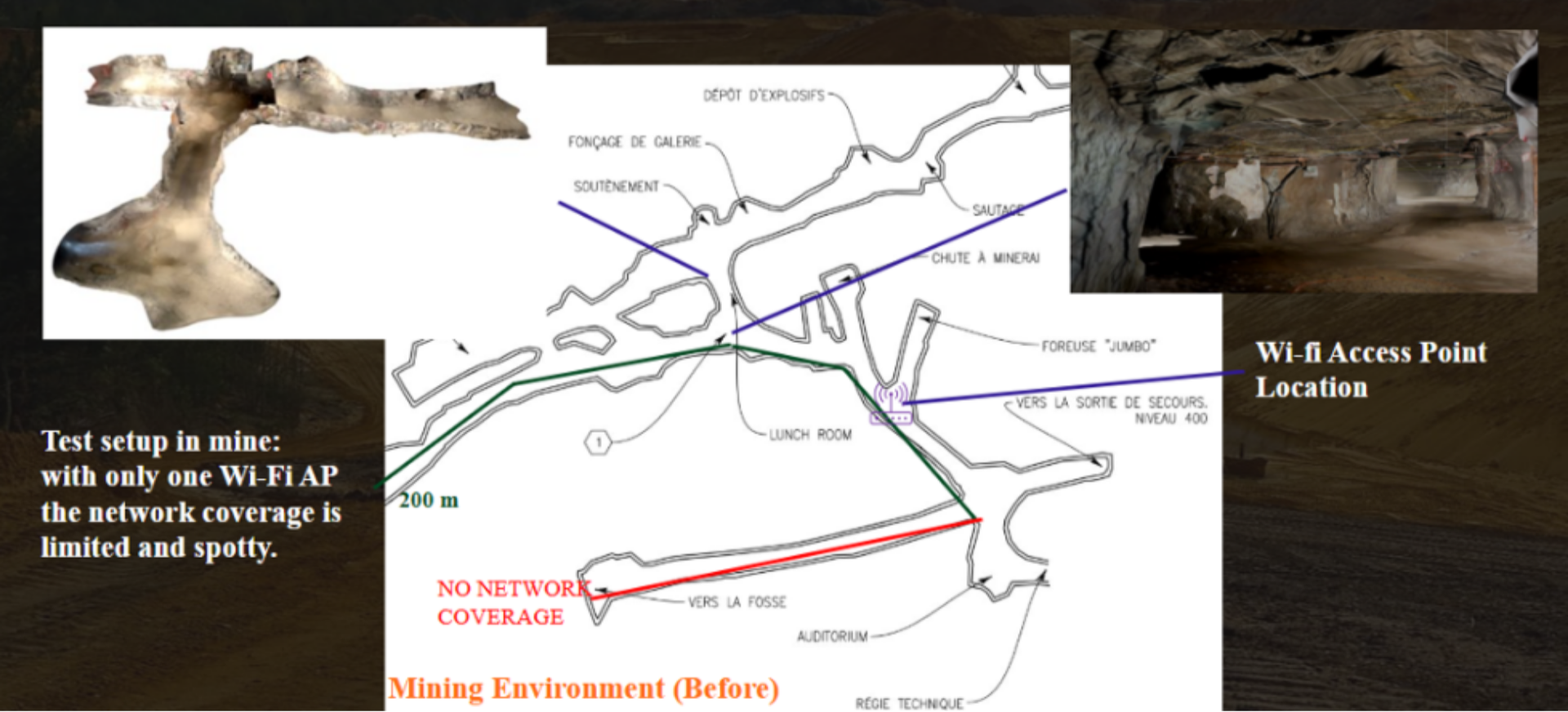
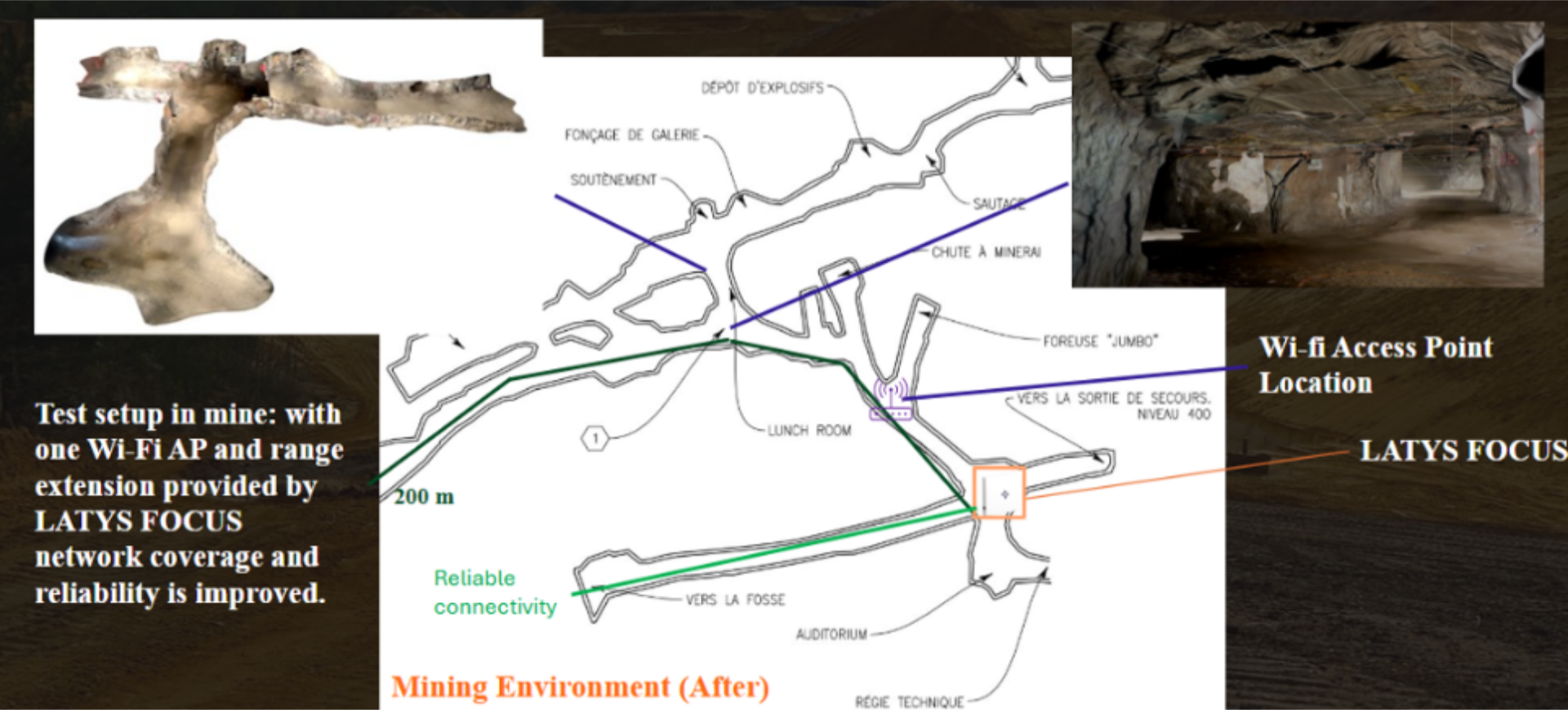
Tunnels coverage before vs after LATYS FOCUS
Val-d’Or:
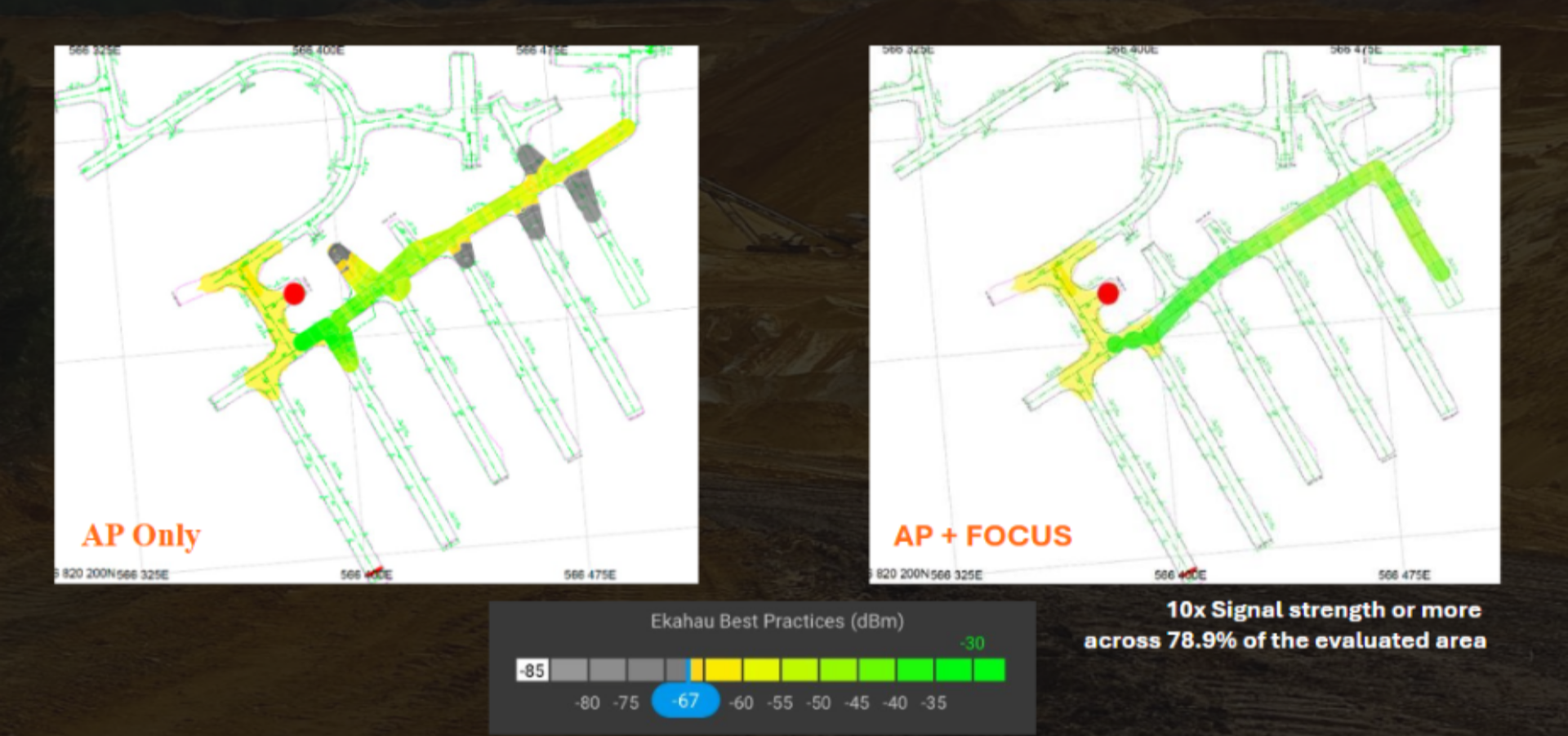
The main challenge was maintaining a reliable connection to a forward-moving drill navigating 90-degree tunnel turns. LATYS FOCUS “bent” the signal around corners, eliminating dead zones and keeping real-time data streaming from the drill to monitoring stations.
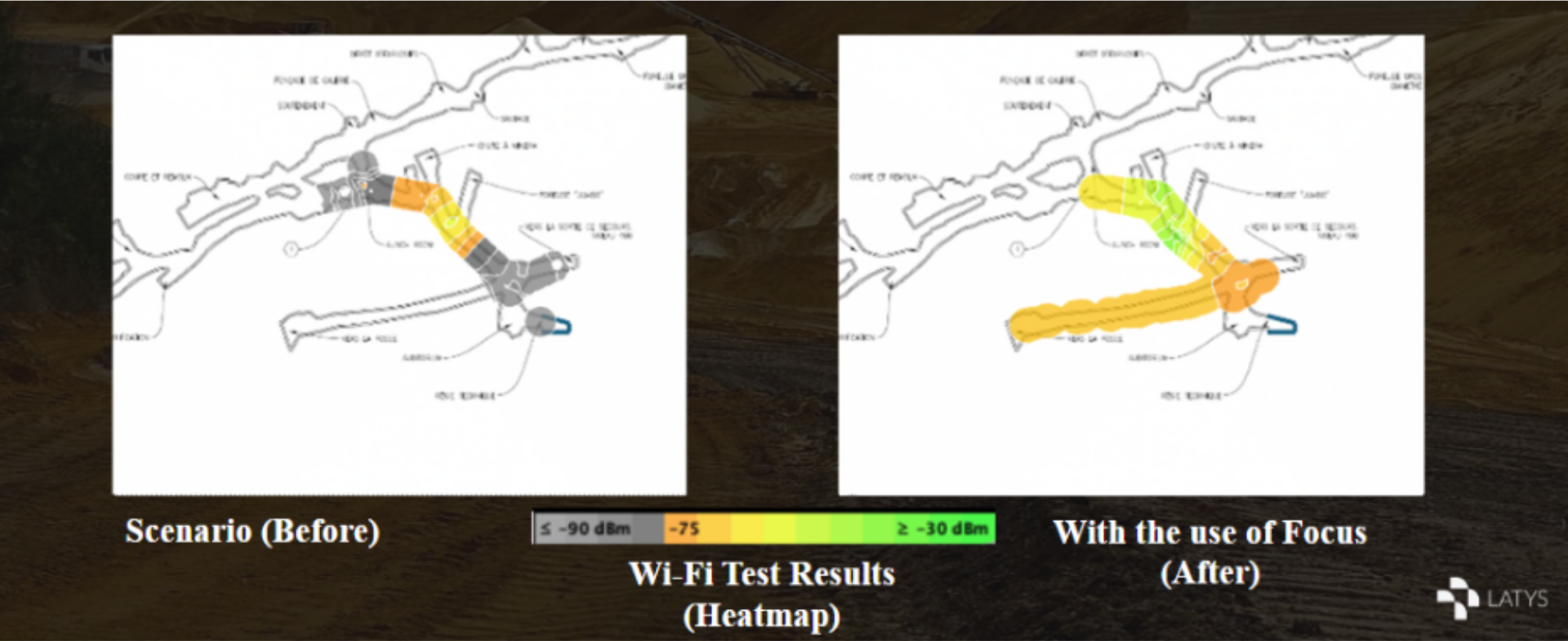
Clear improvement in signal strength, extended connection area.
The absence of red indicates better channel conditions and improved connectivity.
The installation of the LATYS FOCUS in the tunnel at the test point significantly enhanced overall network coverage and quality (not just at the test point).
Nunavik Nickel:
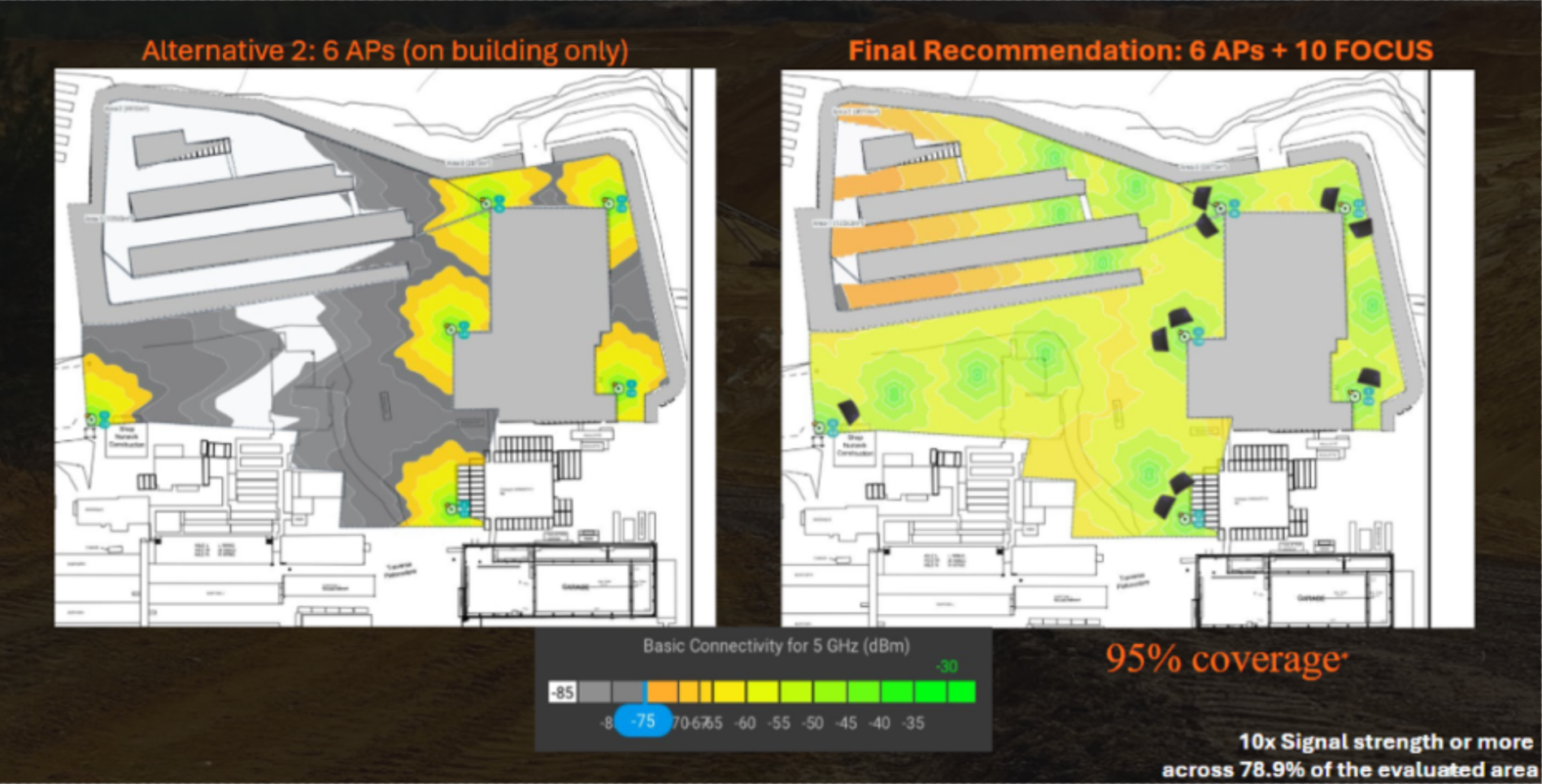
Ten units were deployed across tunnels, warehouses, and control rooms. The system extended coverage from camp to site warehouses (indoors ↔ outdoors), proving robust performance even under harsh conditions.
Results
The deployments produced measurable improvements:
LATYS FOCUS TFR-1040
Warehouse/control rooms before vs after LATYS FOCUS
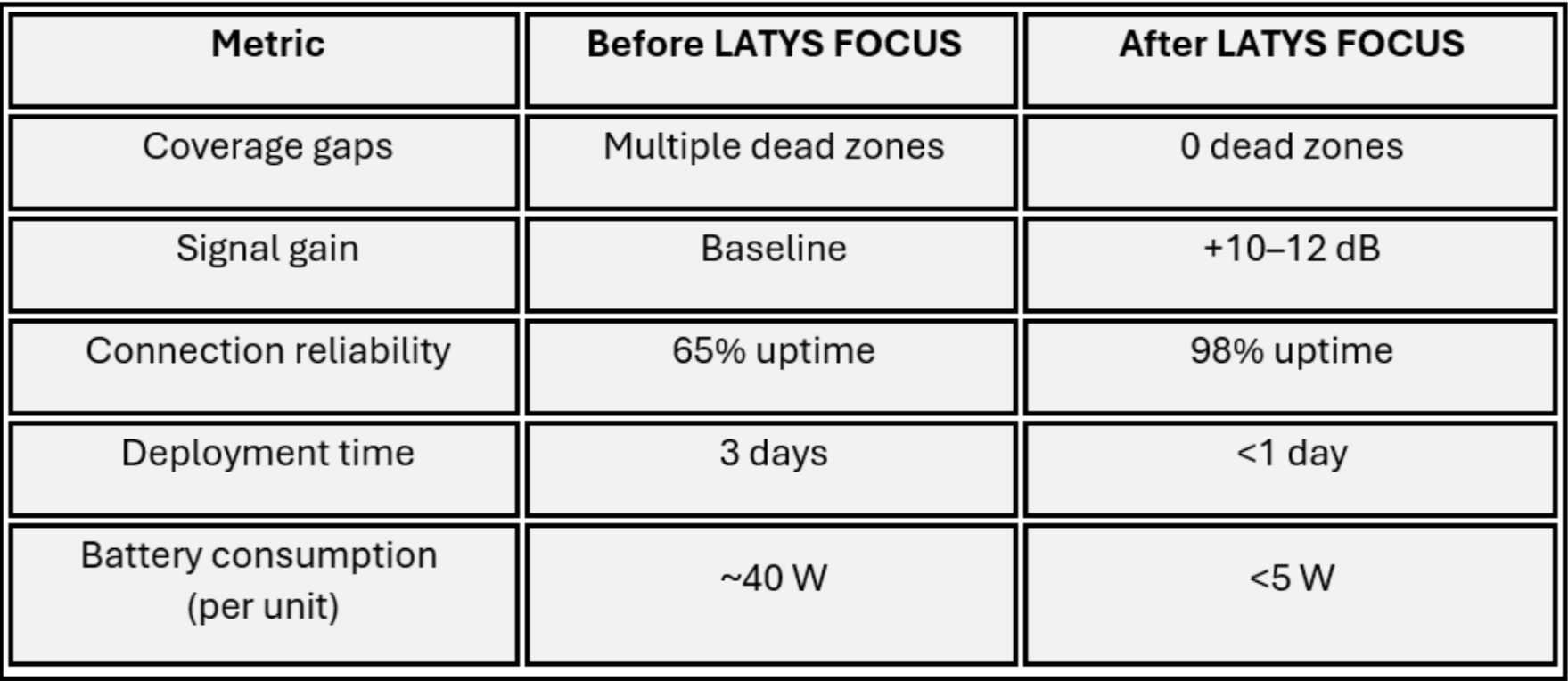
The deployments produced measurable improvements. Coverage gaps, which previously caused multiple dead zones, were eliminated. Signal strength increased by 10–12 dB, and connection reliability jumped from 65% uptime to 98% uptime. Deployment time was reduced from three days to less than one, while battery consumption per unit dropped from around 40 W to under 5 W.
Operators reported smoother communication, uninterrupted IoT sensor data flow, and reliable remote control of equipment. Coverage maps confirmed the elimination of red zones (weak channels), demonstrating uniform, high-quality connectivity across extended areas.
Conclusion
LATYS FOCUS has proven to be a game-changer for underground mining operations. By intelligently directing and amplifying Wi-Fi signals, it enables consistent coverage in areas where traditional solutions fail. Its low power use, ease of deployment, and scalability reduce operational costs while improving worker safety, equipment efficiency, and real-time decision-making.
In short, LATYS FOCUS doesn’t just provide connectivity—it delivers a future-ready communications backbone that supports digital transformation in mining.